
Downtown Infrastructure Project Questions & Answers
- What is the project status, and how did we get here?
The City Council approved the project’s final design and authorized Public Works to put the Downtown Infrastructure Project out to bid in the fall of 2025, with construction tentatively planned to begin in Spring 2026. Design changes were approved by the City Council in January 2026 after bids exceeded cost estimates, and the project was rebid in March 2026. Final bids were received in May 2026. City council approved a bid from Cassela Construction on May 21, 2026. Construction is scheduled to begin in mid-July 2026 and will be completed in three phases over three years. - Why is the City undertaking this project at all?
Much of Keene’s downtown underground infrastructure has aged beyond its useful life, including water, sanitary sewer, stormwater, electrical, telecommunications, and gas – some of which date back over 120 years. The risk of utility outages increases with the age of the infrastructure, and the last major downtown revitalization occurred in 1988. The need for utility improvements is critical to meet the needs of downtown businesses and residents and is now a top priority. - What design did the City Council ultimately approve?
The final design approved by the City Council is based on the “Multilane Hybrid” conceptual design. Key features of the approved design include:- Maintaining current Central Square traffic pattern
- Retaining the existing gazebo, fountain and soldier’s monument
- Slightly enlarging the Central Square park area
- Creating raised crosswalks across at several locations
- Constructing protected bike lanes
- Aesthetic improvements in Railroad Square
- Net increase of 1 parking space
- Removing approximately 63 trees and planting approximately 145 new trees.
- When is the construction taking place?
The construction will be broken up into three phases. Phase 1, occurring mid-July to November 2026, will cover the common, streets, and sidewalks of Central Square. Phase 2, from May to November 2027, will be Main Street from Central Square to roughly Emerald Street. Phase 3, from May to November 2028, will pick up where Phase 2 finished and conclude just south of Water Street.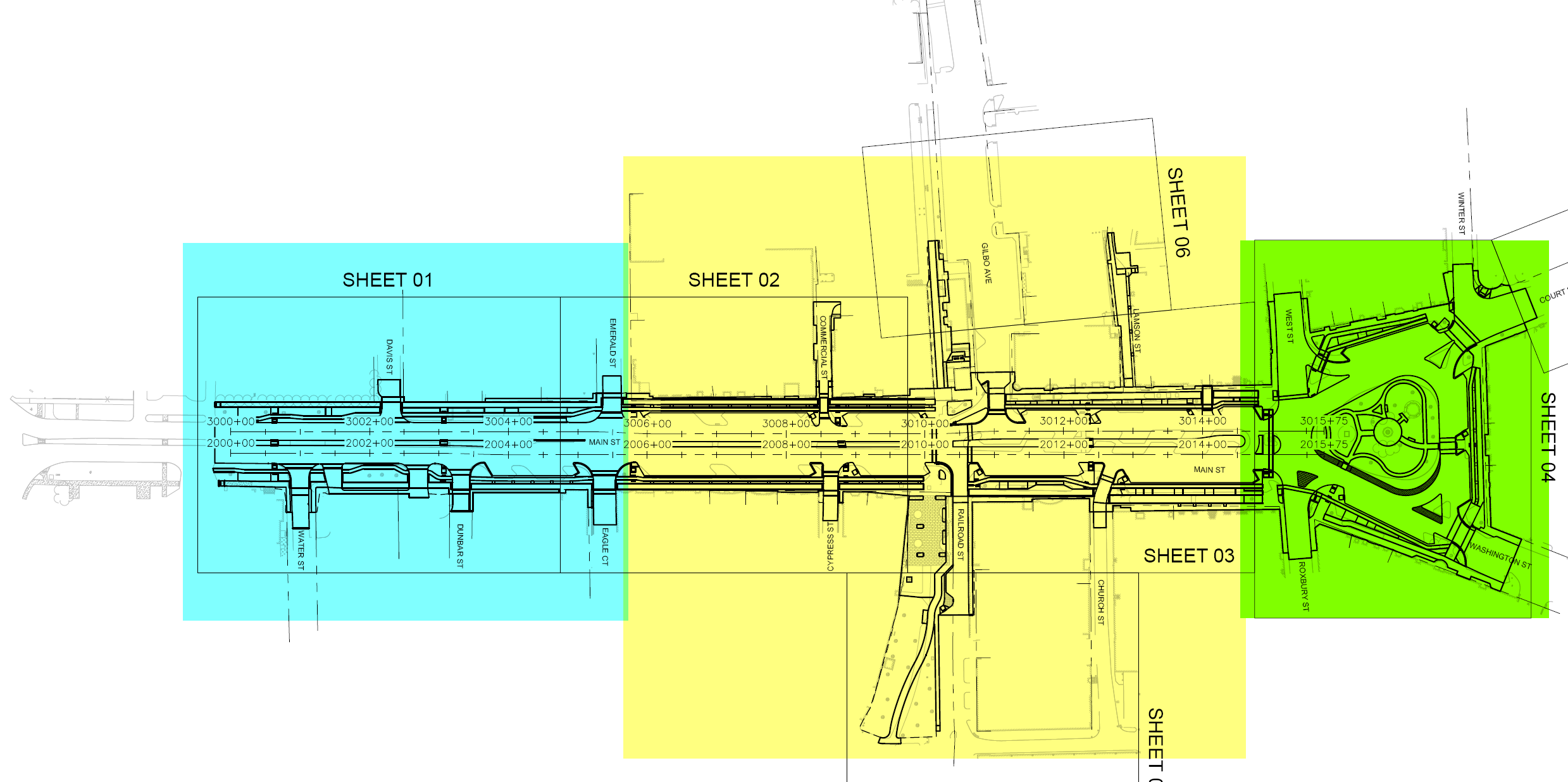
- Can’t we “just do the pipes” to save money?
The extensive infrastructure being replaced is beneath all the lanes on Main Street, Central Square, and connecting streets, and runs perpendicular to the street under the sidewalks, directly into most buildings. It is both more efficient and more cost-effective to open the entire street and sidewalk rather than a patchwork approach, given the extensive infrastructure affected. The patching approach is less functional and would not meet public expectations. - How will Central Square change?
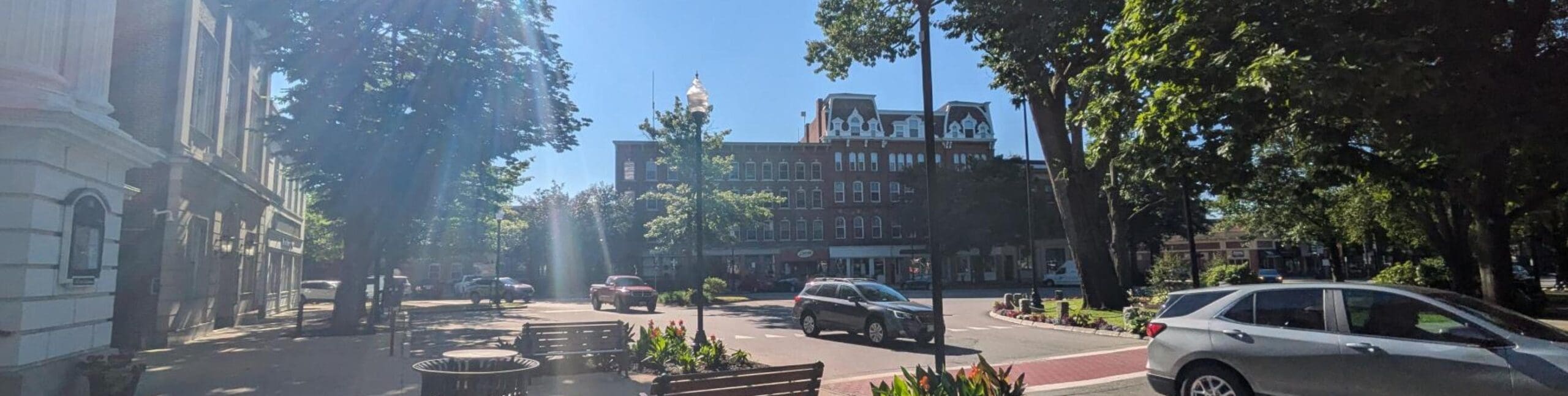
The overall look of Central Square will remain very similar to the current historic look. The bandstand, fountain, statue, and cannons will remain in their current locations. The square itself will expand slightly; the additional space is gained from important traffic flow improvements, including the removal of the slip lane at the south end of the square and a slight reduction in street width to the east and north of the square. Most of the existing trees will remain, except for one diseased tree, and 7 new trees will be planted in the square. - How will the look and feel of the downtown area change?
Keene’s beautiful downtown streetscape will not see significant changes. With the need to resurface all roadways and sidewalks after underground pipes are replaced comes the opportunity to address important needs and make improvements, such as improving safety. There will be basic adjustments to traffic patterns around Central Square, increased sidewalk widths where possible to accommodate outdoor dining areas, better handicap parking options along Main Street, improved crosswalks, and updated traffic signals. The iconic tree canopy – some of which has recently suffered rot and infestations – will also get much-needed attention by planting tree varieties that will thrive in our climate as well as implementing much better root support systems. Some trees will be removed during construction, but new trees will be planted, increasing the total number of trees.
A new protected bike lane at sidewalk level, with a buffer, will replace the current hybrid lanes in the streets. Railroad Square and Central Square will both be refurbished with new paving and landscaping. When the project is finished, everything that makes the downtown experience so special will still be there. The downtown footprint will remain essentially unchanged, but the City Council’s refinishing choices will result in a safer, more inviting space. - Will there be fewer parking spaces after the construction is finished?
No. There will be some shifting of parking spaces due to changes to crosswalks and traffic lanes. The parking spaces in the Main Street median will no longer be there, but the overall downtown footprint will gain some parking spaces. - What about the trees?
The Keene community indicated that our trees are an important part of our downtown look and feel, and the City Council asked the design team to plan for that. Some trees will need to be removed due to health issues, and others will be removed for construction. Many of the existing trees will remain, some will be relocated, and over 100 new trees will be planted, increasing the total number of trees in the downtown area. - Will there still be space for outdoor dining and retail?
Yes. The shift of traffic lanes in the design, where reasonably possible, helps provide for expanded sidewalk space. This will provide more outdoor dining and retail space, as well as additional pedestrian space, across various locations. - Does the final project include bike lanes?
Yes, the City Council voted to include protected bike lanes. The bike lanes will be at sidewalk level, located between the street curb and the sidewalks. There will be protective buffers separating the bike lanes from the sidewalks, and the lanes will be differentiated by color, painted markings, and signage. There will also be pedestrian-only crosswalks with separate bike crossing lanes to maintain pedestrian safety. - What is the City doing to ensure that bike lanes are safe for pedestrians and bicyclists?
City Council has reviewed State of NH regulations and has implemented a City Ordinance, including regulations for the safe use of bike lanes. They have also directed City staff to proactively distribute guidance and education on the safe use of protected bike paths and multimodal spaces. - Is the City making any improvements for ADA accessibility?
Yes. The City will be correcting accessibility deficiencies, including some crosswalks that do not presently have detectable warnings and pedestrian push buttons that do not meet design standards. Widening some sidewalks will also provide more space for outdoor dining while maintaining the required pedestrian space for those using mobility-assistive equipment. - Will downtown remain open during construction?
Yes! There will be times when specific sections of streets or sidewalks will need to be closed, but the majority of Central Square and Main Street, including roads, sidewalks, and parking, will remain open and accessible for the duration of the project. Visitors are encouraged to continue dining, shopping, and frequenting downtown businesses during each construction season. Even when roadways and sidewalks are dug up, parking options and entry to each building will remain available. - How will parking and traffic be impacted during construction?
Construction each season will occur in phases, with crews working on specific sections before moving on to the next. The remaining streets and sidewalks will be fully open. Traffic will remain open in both directions and around the head of the square, though there will be lane shifts to accommodate construction. Outside of construction hours, the streets and sidewalks will be open.
Some parking (in the areas directly under construction) will be closed, while the rest of downtown parking will be available. Notably, the Gilbo East Lot, Commercial Lot, Elm Lot, and spaces along streets adjacent to Main Street and Central Square will continue to provide convenient parking options within close proximity to downtown amenities and resources. - How can I find out more about the project?
The most effective way to stay informed about this project is to sign up for email notifications. These notifications will include regular updates on construction schedules and changes to parking and traffic patterns. Sign up for notifications on the City website at KeeneNH.gov/subscribe.
- More detailed information is posted on the Downtown Project Page at KeeneNH.gov/downtown.
- George Downing, Project Ombudsman, is an impartial, dedicated, and readily accessible point of contact for downtown businesses and residents, ensuring concerns and feedback are heard and addressed. Email George at gdowning@keenenh.gov.
- Public Works will provide updates on construction progress at the monthly City Council Municipal Services, Facilities, and Infrastructure (MSFI) Committee Meetings on the fourth Wednesday of each month at City Hall, typically at 6:00 PM. View the City Calendar on at KeeneNH.gov/calendar for upcoming meeting dates and agendas. These meetings are live-streamed and recorded on the City’s YouTube channel.
- “Coffee and Hard Hats” meetings will be held monthly during the construction season. These are designed as informal roundtable discussions that include representatives from Public Works and the construction team. These meetings are open to anyone interested in attending, and we encourage downtown stakeholders to attend to ask questions, provide feedback, and get key updates about project schedules and impacts. They are currently scheduled for 9:00 AM on the second Wednesday of each month (adjusted to take place at 9AM rather than later in the morning in response to input from downtown businesses). The location in downtown Keene will vary from month to month depending on weather and availability; reminders and locations will be posted on the Downtown Project page and sent via the email notification system.
- How is this being funded?
The City’s CIP (Capital Improvement Plan) details how the various project components will be funded using a combination of capital reserves, current tax revenue, utility rate payments, grants/loan forgiveness, debt, and fund balance if the full project cost is funded with City funds (i.e., assuming no grants). This is a common approach to funding capital improvement projects, designed to minimize the annual property tax impact. The Downtown Infrastructure Project, along with all of the projects identified within the CIP, complies with the City Council’s Fiscal Policy, which limits any property tax revenue increase using a calculation based upon recent changes in the Consumer Price Index (Boston-Cambridge-Newton).